
Arrival: Delhi International Airport (DEL)
1. Upon arrival, meet & greet by our professional tour representative.
2. Transfer to the hotel in a private air-conditioned vehicle.
3. Distance: Airport to Hotel – approx. 15–20 km
Travel Time: 45–60 minutes (depending on traffic)
4. Check-in at hotel and take rest.
5. In the evening, visit a nearby local market (Connaught Place / Karol Bagh / local bazaar) to experience
Delhi’s vibrant lifestyle.
6. Time free for shopping and leisure.
Overnight Stay: Delhi.
After breakfast, proceed for a full-day guided tour of Delhi.
Places to Visit:
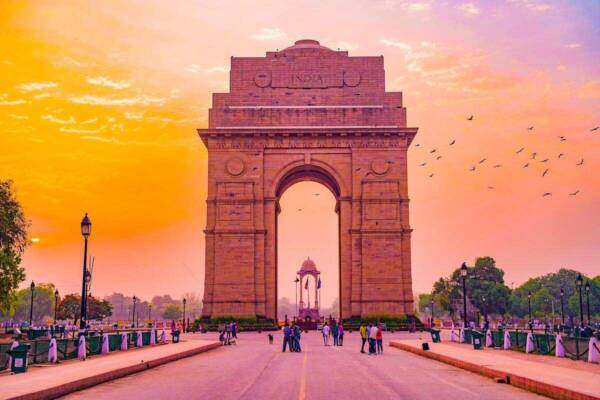
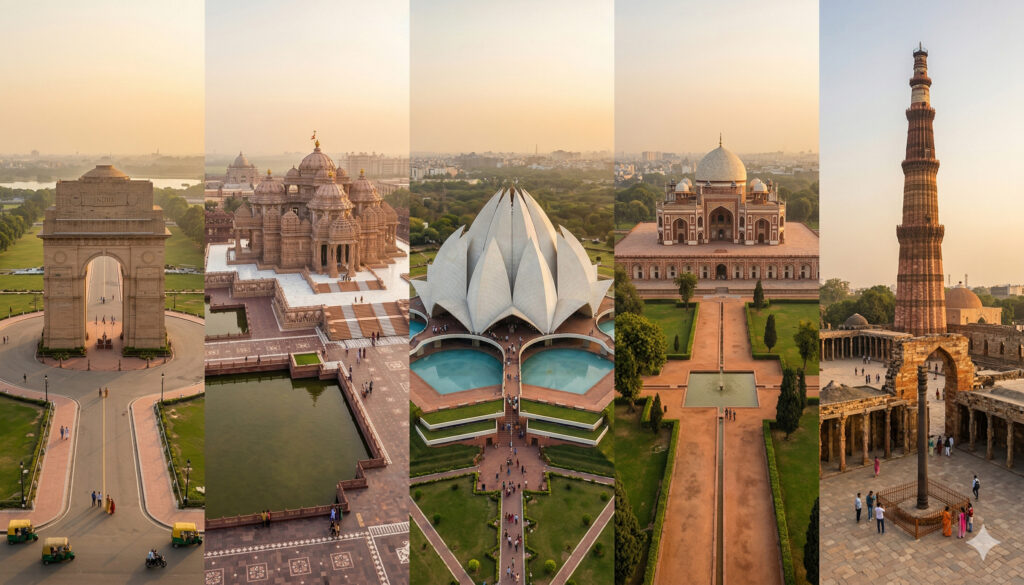
1. India Gate – Iconic war memorial honoring Indian soldiers.
India Gate is a famous historical monument in New Delhi built in memory of Indian soldiers who died
during World War I and the Third Anglo-Afghan War. It was designed by Sir Edwin Lutyens and
completed in 1931. The names of more than 13,000 soldiers are engraved on its walls. Near India Gate
burns the Amar Jawan Jyoti, an eternal flame that honors soldiers who sacrificed their lives for the nation. Surrounded by green lawns, India Gate is a popular tourist spot and looks especially beautiful in the evening. It stands as a symbol of bravery, sacrifice, and national pride.
National War Memorial – A tribute to India’s armed forces (near India Gate).
The National War Memorial in New Delhi is a sacred monument dedicated to Indian soldiers who sacrificed their lives in wars fought after Independence. Inaugurated in 2019, it honors heroes from
conflicts such as the 1947–48 war, 1962 war, 1965 and 1971 wars, the Kargil War, and peacekeeping missions. The names of fallen soldiers are engraved on granite walls in a circular design, symbolizing eternity. At the center burns the Amar Jawan Jyoti, the eternal flame of the immortal soldier.
Surrounded by landscaped gardens, the memorial offers a calm and respectful atmosphere for visitors.
For tourists, it is not just a place to see, but a place to feel India’s courage, sacrifice, and deep respect
for its armed forces.
3. Humayun’s Tomb – UNESCO World Heritage Site and a masterpiece of Mughal architecture.
Humayun’s
Humayun’s Tomb in Delhi is a magnificent Mughal monument built in 1570 by Empress Haji Begum in memory of Emperor Humayun. It was the first garden tomb in India and introduced Persian-style Charbagh architecture, with a grand red sandstone structure, white marble dome, high arches, and symmetrical gardens divided by water channels. The tomb holds great historical value as it marked the beginning of Mughal architectural style in India and later inspired famous monuments like the Taj Mahal. Recognized as a UNESCO World Heritage Site, Humayun’s Tomb represents the artistic
excellence, cultural richness, and royal legacy of the Mughal era.
4. Lotus Temple – Famous for its lotus-shaped architecture (subject to queue & opening hours).
The Lotus Temple in Delhi is a modern architectural marvel built in 1986 and dedicated to the Bahá’í Faith. Designed by Iranian architect Fariborz Sahba, the temple is shaped like a blooming lotus flower made of white marble, symbolizing purity and peace. It is open to people of all religions and beliefs,
promoting unity, meditation, and harmony. The Lotus Temple holds great spiritual and cultural value as a place of silent prayer and reflection rather than ritual worship. Today, it is one of the most visited landmarks in India, admired for its unique design, calm atmosphere, and message of universal
brotherhood.
5. Lunch at Chandni Chowk – Enjoy local street food or restaurant lunch.
6. Akshardham Temple – Grand Hindu temple complex.
Swaminarayan Akshardham Temple in New Delhi is a grand spiritual and cultural complex inaugurated
in 2005, showcasing the teachings of Bhagwan Swaminarayan and India’s ancient traditions. Built with pink sandstone and white marble, the temple is known for its detailed carvings, majestic architecture, exhibitions, and peaceful surroundings. In 2005, the Akshardham complex faced a tragic terrorist
attack, in which innocent lives were lost; the site today stands as a symbol of resilience, peace, and unity. One of its main attractions is the evening musical fountain show, which beautifully presents stories from Indian philosophy using lights, water, music, and narration. Akshardham holds great spiritual, cultural, and educational value and offers visitors a deep experience of India’s heritage and
devotion.
7.Evening Musical Fountain Show at Akshardham (subject to availability).
Local Distance Covered : approx. 40–45 km
Total Travel Time : 5–6 hours including sightseeing.
Overnight Stay: Delhi
After breakfast, check out from the hotel.
1. Drive to Agra by Yamuna Expressway.
2. Distance: Delhi to Agra – approx. 230 km Travel Time: 4–5 hours
3. Upon arrival, check-in at hotel and relax.
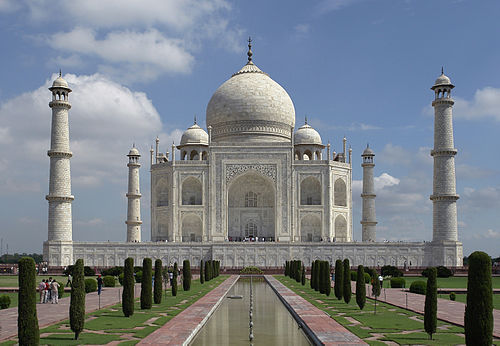
4. In the evening, visit the world-famous Taj Mahal and witness its stunning beauty during sunset.
The Taj Mahal in Agra looks especially magical during the evening and night, when changing light transforms its white marble beauty. At sunset, the monument reflects soft shades of pink, golden, and ivory, creating a peaceful and romantic atmosphere for visitors. On full moon nights, the Taj Mahal is
opened for limited night viewing, when it glows under moonlight and appears almost dreamlike, symbolizing eternal love. Though there are no stage shows inside the monument, the evening time offers a calm experience, and nearby cultural programs and storytelling often explain its history and love story. The evening and night views add great emotional and visual value, making the Taj Mahal one of the most unforgetable experiences for tourists.
Overnight Stay: Agra
After breakfast, explore Agra.
Places to Visit:
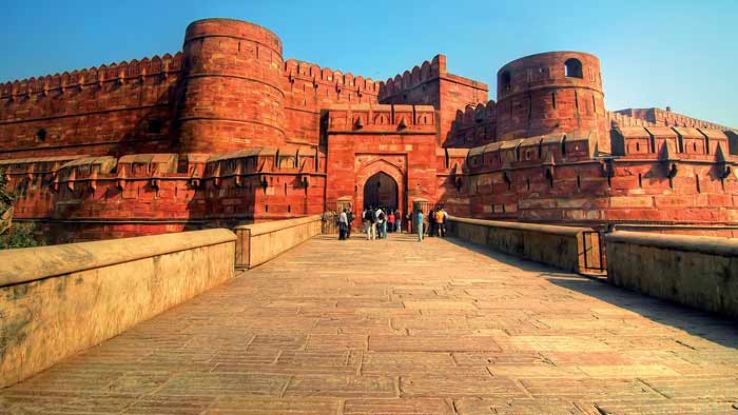
1. Agra Fort – UNESCO World Heritage Site and former Mughal residence.
2. Itmad-ud-Daulah (Baby Taj) – Beauful marble mausoleum.
Lunch at a local restaurant.
Around 3:00 PM, depart for Jaipur.
Distance : Agra to Jaipur – approx. 240 km
Travel Time : 5–6 hours
Arrival in Jaipur, check-in at hotel.
Overnight Stay: Jaipur
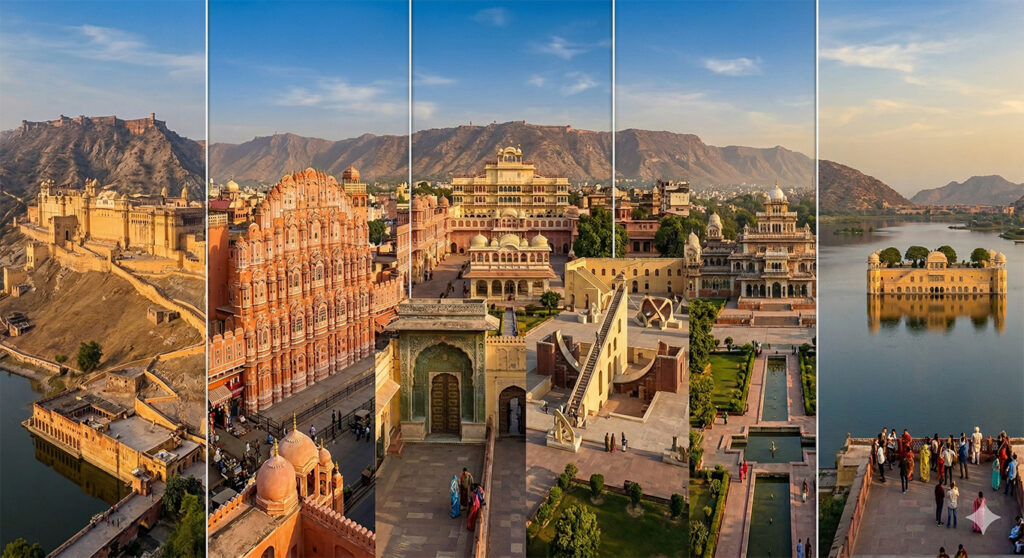
1. Amber Fort, located near Jaipur, is a majestic hill fort built in 1592 by Raja Man Singh I and later expanded by successive Rajput rulers. Constructed with red sandstone and marble, the fort beautifully blends Rajput and Mughal architectural styles.
It served as the royal residence of the Kachwaha dynasty before Jaipur city was founded. Inside the fort, highlights like Sheesh Mahal, Diwan-i-Aam, Diwan-i-Khas, and scenic courtyards attract visitors. Overlooking Maota Lake, Amber Fort is a major tourist attraction known for its grand history, panoramic views, light and sound show, and royal atmosphere, offering travelers a rich glimpse into Rajasthan’s glorious past.
2. Jal Mahal – Water palace (photo stop).
Jal Mahal, meaning “Water Palace,” is a stunning architectural gem located in the middle of Man Sagar Lake in Jaipur. It was originally built in the 18th century by Maharaja Madho Singh I and later renovated by Maharaja Jai Singh II as a royal pleasure palace and hunting lodge.
Designed in a beautiful blend of Rajput and Mughal architecture, the palace is made of red sandstone with five storeys, four of which remain submerged when the lake is full. Surrounded by water and hills, Jal Mahal is admired for its peaceful beauty, symmetrical design, chhatris, and arched corridors. Though entry inside is restricted, it remains a popular tourist attraction for photography and sunset views, reflecting the royal elegance of Jaipur’s heritage.
3. Hawa Mahal – Palace of Winds.
Hawa Mahal, also known as the “Palace of Winds,” is one of Jaipur’s most iconic landmarks, built in 1799 by Maharaja Sawai Pratap Singh. Made of pink sandstone, this unique five-storey structure was designed so that royal women could observe street festivals and daily life without being seen, following the tradition of purdah.
Its beautiful façade has 953 small windows (jharokhas) with intricate latticework that allows cool air to flow through the palace, keeping it naturally ventilated. Hawa Mahal attracts tourists for its honeycomb design, historical importance, city views from the top, and its status as a symbol of Jaipur’s royal architecture and cultural charm.
4. City Palace – Royal residence & museum.
5. Jantar Mantar UNESCO-listed astronomical observatory.
Jantar Mantar in Jaipur is a historic astronomical observatory built in 1734 by Maharaja Sawai Jai Singh II, a scholar king with a deep interest in science and astronomy. It features a collection of large stone instruments designed to measure time, track celestial movements, and predict eclipses with remarkable accuracy.
The observatory reflects a unique blend of scientific knowledge and architectural skill of ancient India. Recognized as a UNESCO World Heritage Site, Jantar Mantar is an important tourist attraction where visitors can learn about India’s advanced astronomical heritage while enjoying its impressive geometric structures and historical significance.
6. Albert Hall Museum – Oldest museum in Rajasthan.
Albert Hall Museum in Jaipur, also known as the Central Museum, is the oldest museum in Rajasthan, established in 1887 and designed by Sir Samuel Swinton Jacob. Built in Indo-Saracenic style with stunning arches, domes, and intricate stonework, it was inaugurated in 1887 during the visit of the Prince of Wales, later King Edward VII.
The museum houses an extensive collection of artifacts, including paintings, sculptures, textiles, carpets, jewelry, and ancient manuscripts, representing the rich art, culture, and history of Rajasthan and India. A major tourist attraction, Albert Hall Museum offers visitors a chance to explore India’s heritage, enjoy its architectural beauty, and learn about centuries-old traditions and craftsmanship in a single location.
7. Local Jaipur Bazaar – Shopping for handicrafts, jewelry & textiles.
Local Distance Covered: approx. 35–40 km
Total Travel Time: 5–6 hours
Overnight Stay: Jaipur
After breakfast, check out from the hotel.
Drive back to Delhi.
Distance: Jaipur to Delhi – approx. 280 km
Travel Time: 5–6 hours
1. Arrival in Delhi and check-in at hotel.
2. Evening free for leisure or last-minute shopping.
Overnight Stay: Delhi
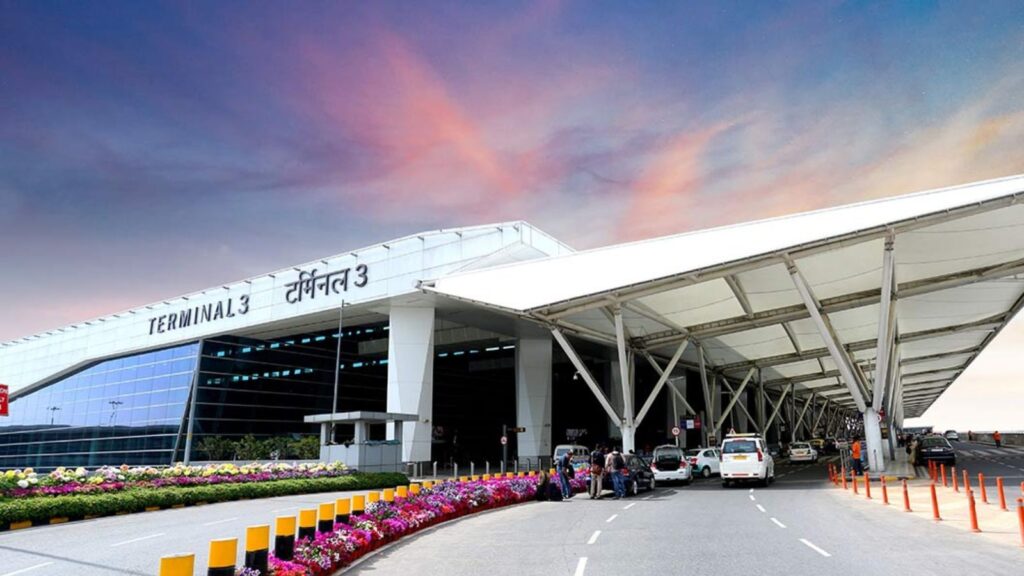
After breakfast, check out from the hotel.
Transfer to Delhi International Airport for onward journey.
Distance: Hotel to Airport – approx. 180°C – 20 km
Travel Time: 45–60 minutes
Tour Ends with Sweet Memories of Incredible India